
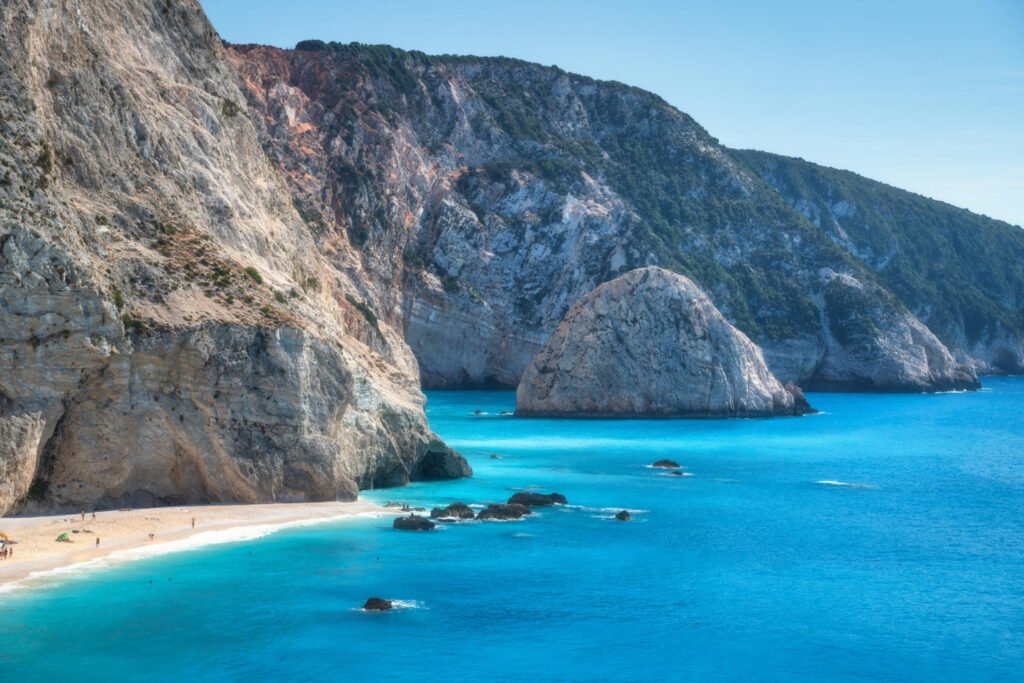
For the better part of two decades, “luxury Greek island” has meant one thing to most international travelers: the Cyclades. Santorini’s caldera-view suites, Mykonos’s cliffside villas, the whitewashed aesthetic that’s become shorthand for Greek summer in travel media worldwide. That default is starting to shift. A growing number of high-end travelers — many of whom have already done Santorini and Mykonos multiple times — are now looking west, to the Ionian Islands, for a version of Greek luxury that feels less saturated and considerably more private. The shift isn’t dramatic or sudden; it’s the kind of gradual repositioning that tends to happen once enough infrastructure, recognition, and word-of-mouth accumulate behind a destination that was previously overlooked by the luxury segment specifically.
Why the Cyclades became the default in the first place
The Cyclades’ dominance isn’t accidental. The volcanic caldera views of Santorini and the cosmopolitan energy of Mykonos are genuinely unique, and decades of concentrated hotel investment have built an ecosystem of five-star properties, from boutique cave suites to sprawling resort complexes, that simply didn’t exist elsewhere in Greece until relatively recently. For a first-time luxury visitor to Greece, the Cyclades remain, in many respects, the obvious choice — reinforced by decades of media coverage, film and television appearances, magazine editorials, and an instantly recognizable visual identity that’s difficult for any other Greek region to compete with on brand recognition alone.
What’s changing in the Ionian
The Ionian Islands have always had the natural ingredients for luxury travel — turquoise water, dramatic coastlines, a gentler, greener landscape than the arid Cyclades — but historically lacked the hospitality infrastructure to match. That’s changed meaningfully over the past several years. Zakynthos, in particular, is emerging as the clearest example: the island is now home to Lesante Blu Exclusive Beach Resort, an all-suite, adults-only property that became the first hotel in the entire Ionian Sea to join the Leading Hotels of the World — a distinction that places Zakynthos, almost overnight, in the same conversation as far more established luxury destinations.
The difference this makes for travelers
For travelers who’ve already experienced the Cyclades’ particular brand of luxury — dramatic views paired with high density and heavy summer crowds — the appeal of the Ionian is fairly direct: comparable, and in some respects higher, standards of privacy and service, without the crowds. An all-suite resort tucked into the quiet village of Tragaki on Zakynthos’s northeast coast offers genuine seclusion as a baseline rather than a premium add-on, with every suite including a private pool — a feature that, in much of the Cyclades, is still reserved for top-tier room categories rather than guaranteed across the board.
Dining has followed a similar trajectory: a fine-dining scene has caught up with FNL Star recognition and Master of Wine-curated cellars now attached to Ionian properties, a level of culinary credentialing that, until recently, was almost exclusively associated with hotels in Athens, Santorini, or Mykonos. For a closer look at how the island’s top properties measure up individually, see Best Hotels in Zakynthos — Top 5 (2026).
Access and practical considerations
Part of what kept the Ionian off the luxury radar for so long was simple logistics. Santorini and Mykonos benefit from dense, well-established flight networks and decades of tour-operator infrastructure built specifically around high-end travel. Zakynthos and the wider Ionian have historically been positioned more toward mainstream package tourism, particularly from the UK market. That’s shifting too, with expanding direct flight capacity from Northern Europe and a growing number of properties offering the kind of private transfer and concierge-level arrival experience that luxury travelers now expect as standard. It’s not yet at Cycladic density, but the gap is narrowing faster than it has at any point in the past decade.
A broader shift in traveler behavior
This isn’t happening in isolation. It reflects a wider pattern across the luxury travel industry: increasingly, well-traveled guests are prioritizing exclusivity and genuine quiet over globally recognizable scenery, and are willing to look slightly off the beaten path to get it. That instinct extends beyond hotel choice into how entire itineraries get planned, with travelers building trips around specific properties and experiences rather than simply defaulting to whichever island has the most name recognition.
How the two regions actually compare
It’s worth being precise about what’s changing and what isn’t. The Cyclades still offer a far larger volume of five-star properties, a longer track record, and — for travelers whose priority is nightlife and social energy — an experience the Ionian simply isn’t built to replicate. What’s shifted is the assumption that “Cyclades” and “Greek luxury” are effectively synonymous. A short list of Top 5 Luxury Hotels in the Ionian Islands 2026, now stands up credibly against comparable Cycladic shortlists, particularly for travelers prioritizing privacy, all-suite layouts, and internationally certified quality over caldera views specifically.
A note on price positioning
One assumption worth revisiting is that Ionian properties are automatically less expensive than their Cycladic counterparts. That’s no longer reliably true. As international certification and fine-dining recognition have arrived on islands like Zakynthos, pricing at the top end has moved to reflect it, particularly at properties offering the all-suite, guaranteed-privacy model. The gap that remains is less about price and more about volume of choice: the Cyclades simply offer more five-star inventory across more price points, while the Ionian’s luxury offering is smaller but increasingly comparable at the top tier specifically.
What this means for 2026 travel planning
For travelers weighing the two regions this year, the decision increasingly comes down to what “luxury” actually means to them, rather than which islands happen to be more photographed. Those who want the recognizable Cycladic aesthetic, dense nightlife, and a well-worn luxury infrastructure still have every reason to choose Santorini or Mykonos. But for a growing segment of travelers — particularly repeat visitors to Greece, couples prioritizing privacy, and anyone specifically seeking an adults-only, all-suite standard of accommodation — the Ionian, and Zakynthos specifically, has moved from a secondary option to a genuine first choice, backed by exactly the kind of international hospitality validation that once belonged almost exclusively to the Cyclades. As that validation continues to build, the two regions look increasingly like peers rather than a hierarchy — a shift that would have seemed unlikely as recently as five years ago, and one that is likely to keep accelerating as more Ionian properties pursue the same kind of international validation that put Zakynthos on the map.
You might also be interested in: Villa Transfers in Mykonos: Why Luxury Villas Need Organized Private Transportation